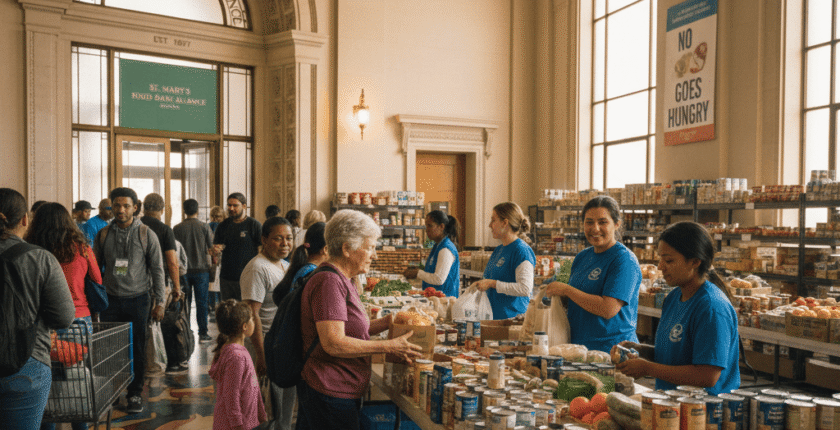
Imagine, you’re strolling down the streets of your city when you see a long line of people outside what looks like a bank. But they aren’t there to deposit checks or withdraw cash. Instead, they are waiting patiently to fill their empty bags with food supplies. This isn’t any ordinary bank; it’s a food bank. Now, you may be asking yourself, “Can anyone go to the food bank?”
Understanding the Concept of Food Banks
A food bank is essentially a nonprofit organization that collects and distributes free groceries to those in need. It operates similarly to an actual ‘bank’, except instead of dealing with money, it deals with essential food items.
The concept of food banks originated in the United States but has now spread globally. The first ever food bank, called St. Mary’s Food Bank Alliance, was established by John van Hengel in Phoenix, USA in 1967. Today, countless such organizations operate across all states and cities within the USA and abroad.
The Prerequisites for Utilizing a Food Bank
The question remains: can anyone go to the food bank? Well, while most food banks aim to serve everyone struggling with hunger issues without discrimination, not everyone can just walk into one and demand assistance.

- Income Status: Most U.S.A banks determine eligibility based on income status and poverty level as per federal standards.
- Situational Need: Some people might qualify due to temporary circumstances such as job loss or medical emergencies.
- Domicile: Certain banks require proof that you live within the service area of that particular bank.
A Comparison between Different Types of Food Banks
| Type of Food Bank | Services | Eligibility |
|---|---|---|
| Public | Available to all in need regardless of income or location. | No specific requirements |
| Private | Caters specifically to families and individuals with low income. | Proof of income status |
| Church-Based | Typically serve their local community or congregation. | May require proof of address in the locality |
Process to Access a Food Bank
The process to access a food bank can vary from one organization to another. But here’s a general step-by-step procedure:
- Contact your local food bank.
- Provide them with necessary information about your financial situation.
- If you meet the criteria, they will set up an appointment for you.
- During this appointment, you may receive your food supplies or be scheduled for regular pick-ups.
Navigating the Stigma Associated with Food Banks
Sometimes people hesitate to use food banks due to social stigma. It’s important we foster an understanding that needing help is not something to be ashamed of. Food banks are there as a safety net for anyone who finds themselves unable to afford basic necessities – and there’s no shame in utilizing them when needed.
Can I go to any food bank?
Do I have to pay anything at the food bank?
What kind of identification do I need?
How often can I get help from a food bank?
Are there other services provided by food banks?
Can I volunteer at a food bank?
What kinds of foods can I get from a food bank?
Can undocumented immigrants use food banks?
What if there isn't a food bank in my area?
Do I need to bring my own bags when visiting a food bank?
In conclusion, while anyone struggling with hunger or financial hardship can seek help from a food bank, certain criteria may need to be met. Remember, they exist as an essential resource for those in need – helping create a society where no one has to go hungry.